

Understanding the Core of Caregiver Assistance Programs
A caregiver assistance program provides essential support to family and friends who care for loved ones at home. These programs offer services like respite care, counseling, training, and financial support—all designed to reduce stress and prevent burnout.

What Caregiver Assistance Programs Typically Provide:
- Respite Care – Temporary relief for caregivers.
- Counseling & Support Groups – Emotional support and peer connections.
- Training & Education – Skills for daily care and medical tasks.
- Information & Referral – Help navigating healthcare and community resources.
- Financial Support – Reimbursement for supplies and services (varies by program).
- Care Management – Personalized needs assessment and care planning.
Nearly one in four adults provides unpaid care to a family member or friend. The statistics are staggering, but they don’t show the human cost: more than half of family caregivers feel exhausted, anxious, and overwhelmed.
Caregiving can be both meaningful and isolating. You might not even identify as a “caregiver”—you’re just helping with groceries, appointments, or medications. But these responsibilities add up, leaving little time for your own health and personal goals.
This is where caregiver assistance programs become a lifeline. Whether you’re caring for an older adult, a person with Alzheimer’s, or a grandchild, these programs exist to support you. They’re typically funded through federal initiatives like the Older Americans Act and administered locally, making them accessible nationwide.
At Abby Senior Care, we’ve supported countless families through every stage of the caregiving journey. Our team has seen how caregiver assistance programs can transform an experience from overwhelming to manageable, and we’re here to guide you through your options.
Understanding the Core of Caregiver Assistance Programs
When we talk about a caregiver assistance program, we’re describing a structured support system for people providing unpaid care to a loved one. The heart of these programs is to make your caregiving journey sustainable, reduce your stress, and help you find moments of peace.
More than half of family caregivers report feeling exhausted and overwhelmed. Caregiver assistance programs step in at this point, offering practical help to prevent burnout. At Abby Senior Care, we’re committed to providing Advice for Family Caregivers that helps you steer these situations with confidence.
Before we go further, let’s clarify a few important terms:
- Caregiver: You. A family member, friend, or neighbor providing unpaid support to someone with a long-term illness, disability, or age-related needs.
- Care recipient: The person receiving your care—often an older adult, someone with a chronic illness or disability, or a person with Alzheimer’s disease.
- The Older Americans Act (OAA): The federal law that funds many public caregiver support programs. Its Family Caregiver Support Program specifically targets informal, unpaid family caregivers.
What is the primary goal of a caregiver assistance program?
The main purpose is to empower you and make your role sustainable. These programs recognize that if you burn out, everyone suffers. The goals are practical and person-centered, working to:
- Reduce your caregiver burden with services like respite care.
- Help you stay in the workforce, as many caregivers struggle to balance a job with care duties.
- Delay the need for higher-level institutional care, allowing loved ones to remain at home longer.
- Focus on your health and well-being—physically, emotionally, and mentally. We’re passionate about helping you Combat Caregiver Stress before it becomes overwhelming.
The goal is to improve quality of life for both you and your loved one.
Who provides these programs?
Support comes from a network of resources at different levels:
- The federal government funds major programs through agencies like the U.S. Administration for Community Living and the Department of Veterans Affairs, often via the Older Americans Act.
- State agencies, like your state’s Department of Aging, administer federal funds and often add their own state-specific programs.
- Area Agencies on Aging (AAAs) are your local connection. These community-based organizations bring federal and state programs to your neighborhood and are the best first call when you need help.
- Non-profit organizations like the Alzheimer’s Association offer specialized support, education, and advocacy, filling critical gaps.
- Home care agencies like Abby Senior Care play an important role by offering professional services and resources. In communities throughout Colorado—including Arvada, Aurora, and Centennial—we work with families to provide the breaks and support they need.
The key takeaway? Help exists at every level. The challenge is knowing where to look—which we’ll cover next.
What Types of Support Can You Receive?

Your caregiving situation is unique, which is why a good caregiver assistance program provides custom services built around your specific needs. Most programs begin with a needs assessment from a care manager, who acts as your guide to create a person-centered care plan. For additional guidance, explore our Caregiver Tips.
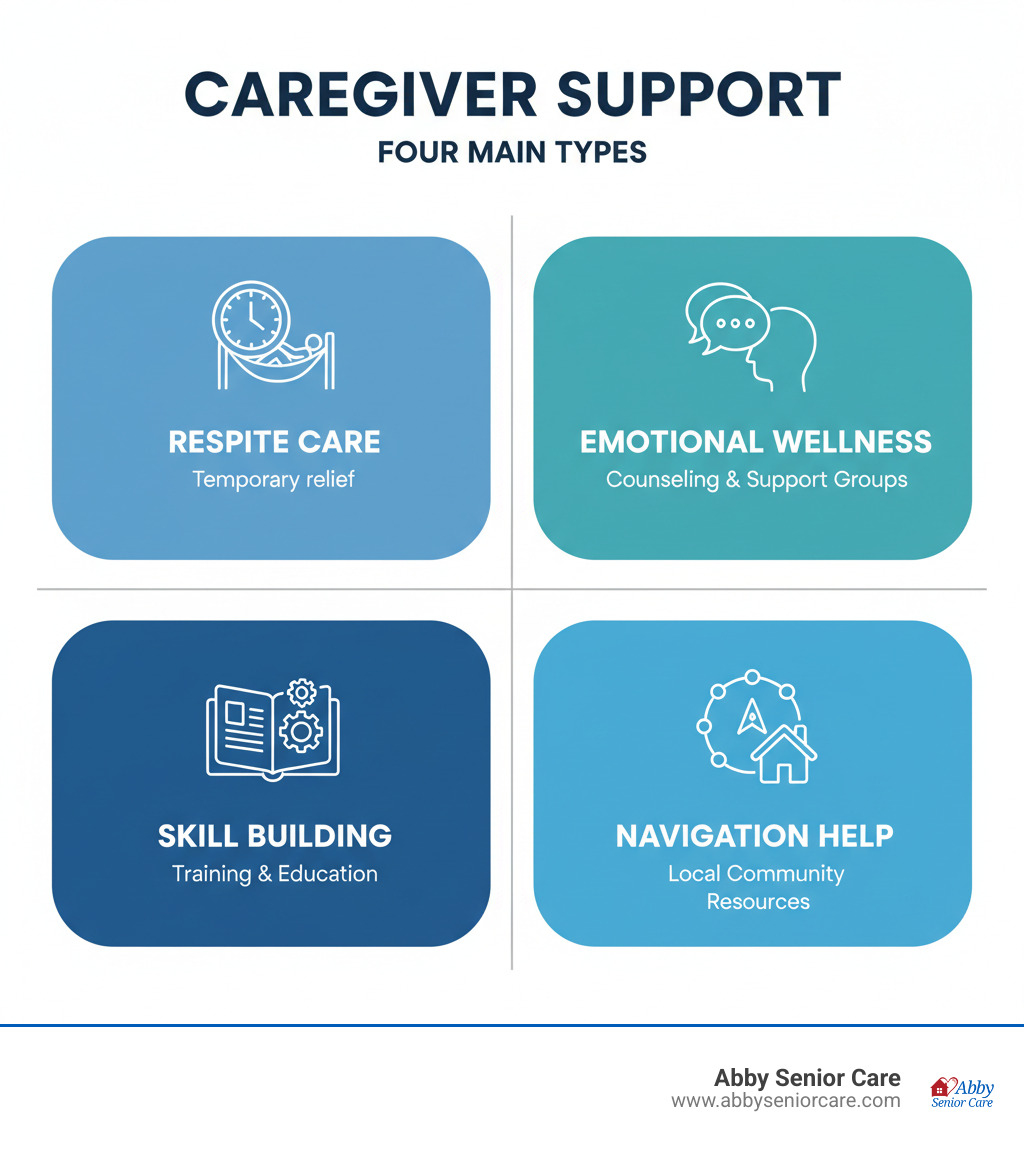
Support typically falls into three main categories: respite care for essential breaks, emotional and educational resources, and connections to local community services.
Respite Care: Your Essential Break
Many caregivers struggle to admit it, but you need time away. Respite care is temporary, short-term care for your loved one that gives you permission to step away and recharge. This could be a few hours, a weekend, or even a week, depending on the program and your needs.
Respite care is flexible. It can happen in your home with a trained professional, at an adult day center, or through short stays at a residential facility. Why does this matter? Over half of family caregivers feel exhausted and overwhelmed. Respite care is one of the most powerful tools to prevent Caregiver Burnout.
Taking a break isn’t selfish—it’s strategic. When you return from respite, you’re more patient, present, and better equipped to provide quality care. Learn more about how you can Benefit From Home Care Services that include respite options.
Emotional and Educational Support
A good caregiver assistance program recognizes you need emotional support just as much as practical skills.
- Individual counseling offers a private space to process stress, guilt, and grief with a trained professional who can help you develop coping strategies.
- Support groups, in person or online, connect you with peers who truly understand what you’re going through. As one caregiver said, “This is a space where I feel understood, supported, and never judged.”
- Caregiver training and educational workshops build your knowledge and confidence. Sessions cover topics like dementia care, safe lifting techniques, and medication management.
The goal is to help you become a more informed, skilled, and confident caregiver. Knowledge is power, and you can reflect on your growth through practices like Caregiver Journaling.
Local Community Resources and Guidance
Navigating healthcare systems and community services can be overwhelming. Information and referral services are a critical part of caregiver assistance programs, acting as your central point of contact for everything from meal delivery to transportation.
Many programs also provide navigation help through care managers who guide you through applications and eligibility requirements. They help you understand your Role of Family Caregiver and how various programs can support you.
Your community likely has more resources than you realize, such as adult day programs that provide supervised care and activities for your loved one. The Eldercare Locator is an excellent starting point for finding trustworthy local support, connecting you directly with your local Area Agency on Aging in Denver, Lakewood, Highlands Ranch, or any other community.
Navigating Eligibility and Applications
Applying for a caregiver assistance program is more straightforward than you might imagine, but every state and program has its own rules. Think of it as uncovering resources that can genuinely change your life. Let’s walk through what you need to know.
General Eligibility for the Caregiver and Care Recipient
Eligibility usually depends on both your situation and the needs of the person you care for. While programs differ, here are some common threads:
- The Caregiver: Must typically be an unpaid, informal caregiver (spouse, child, friend) who is 18 or older and lives in the program’s service area.
- The Care Recipient: Most programs focus on adults age 60 or older who need help with daily tasks like bathing or dressing. Many also extend eligibility to individuals of any age with Alzheimer’s disease or a related disorder, and some support adults (18-59) with disabilities.
If you’re Caring for an Aging Parent, these programs are designed with situations like yours in mind.
Understanding Program Requirements
Beyond basic eligibility, each caregiver assistance program has its own specifics. Services like information and emotional support are usually available to everyone, regardless of income. However, programs offering financial reimbursement often have income-based criteria.
For example, some state programs use a sliding scale for financial support. A household with lower income might receive 100% reimbursement for approved expenses, while a household with higher income might receive a smaller percentage. This ensures that those who need the most financial help get it.
Most programs require a needs assessment, which is a friendly visit from a care manager to understand your situation. They’ll work with you to create a person-centered care plan that fits your life. Be aware that some exclusions may apply, such as if the care recipient is already enrolled in certain Medicaid long-term care programs.
How to find and apply for a caregiver assistance program
Here’s your step-by-step guide to finding and applying for help:
- Start with the Eldercare Locator. This nationwide service connects you with local resources. It will point you to your local Area Agency on Aging.
- Contact your local Area Agency on Aging (AAA). These Area Agencies on Aging (AAAs) are the heart of most caregiver support services. They know what’s available in your specific area—whether it’s Golden, Lone Tree, or Westminster—and will assign a care manager to guide you.
- Check your state’s Department of Aging website. This is a great source for information on state-specific programs, including Medicaid waivers.
- Explore non-profit and veteran resources. Groups like the Alzheimer’s Association and the Department of Veterans Affairs offer specialized programs.
- Complete the needs assessment and gather documentation. Once connected with a program, a care manager will assess your needs. Be ready with proof of age, residency, and medical diagnoses to speed up the process.
Yes, there’s paperwork, but you’re opening a door to support that can help you continue caring for your loved one without losing yourself.
Specialized Programs for Diverse Caregiving Situations

No two caregiving situations are the same. That’s why specialized caregiver assistance programs exist to meet you where you are. Whether you’re Caring for an Older Adult, raising younger family members, or juggling a career, there’s support designed for your situation.
Programs for Grandparents and Kinship Caregivers
If you’re a grandparent or older relative raising children (a “grandfamily”), you face unique challenges, from financial strain to navigating school systems. The Older Americans Act (OAA) Family Caregiver Support Program recognizes this. If you’re 55 or older and have primary responsibility for a child under 18 or an adult with a disability, you may qualify for support like information services, respite care, and counseling.
National and local organizations also provide resources. The Grandfamilies & Kinship Support Network offers advocacy and information, while legal aid groups can help with school enrollment. Financial support may also be available through programs for food, child care, and healthcare. Your local county assistance office or state Department of Human Services can guide you to these options.
Resources for the Working Caregiver
One in three employees is also a caregiver. If you’re balancing a job with care duties, you know how exhausting it can be. Fortunately, the workplace landscape is slowly changing to offer more support.
- Flexible work arrangements like telecommuting, compressed workweeks, or part-time schedules can make a huge difference.
- Employer-provided resources may be available through your company. Check with your HR department about Employee Assistance Programs (EAPs) for confidential counseling, referral services, or paid family leave benefits.
- State-mandated paid family leave programs exist in several states, compensating you for time off to care for a family member. Contact your state labor office for details.
- For Canadian caregivers, the Employment Insurance (EI) Caregiving Benefits offer financial assistance for time off work to care for a critically ill or injured person.
We know it’s hard to Balance a Career with Care Duties. These resources are designed to help you manage both your professional and personal responsibilities.
Frequently Asked Questions about Caregiver Assistance
We know you have questions. Here are clear, straightforward answers to some of the most common ones we hear.
Can I get paid for being a family caregiver?
Sometimes, yes. While not always straightforward, several avenues are worth exploring:
- Medicaid programs in many states offer “consumer-directed” services that allow eligible individuals to hire and pay family members as caregivers. Contact your state’s Medicaid office for details.
- Long-term care insurance policies sometimes allow family members to be paid for care. Check your loved one’s policy for confirmation.
- Paid family leave programs in several states provide compensation for time off work to care for a family member. Check with your state labor office for specifics.
- VA programs like the Veteran-Directed Care program and Aid and Attendance benefits may provide funds to hire a caregiver, including a family member. Contact your local VA office to see if you qualify.
While Abby Senior Care doesn’t directly pay family caregivers, we can help you explore these options and connect you with local resources in areas like Arvada, Aurora, and Cherry Hills Village, Colorado.
What is the first step to finding help in my area?
The best starting point is the Eldercare Locator, a public service of the U.S. Administration on Aging. You can call them (1-800-677-1116) or visit their website.
The Eldercare Locator will connect you with your local Area Agency on Aging (AAA), your community’s hub for caregiver resources. Your local AAA can explain what caregiver assistance programs are available in your area—whether you’re in Denver, Lakewood, or Westminster—and guide you to the right services.
Do I have to be low-income to qualify for help?
Not always. This is a common misconception. While some programs offering direct financial aid do have income limits, many forms of support are available to all caregivers.
- Information services, counseling, and support groups are often available to everyone, regardless of income.
- Respite care programs are frequently offered on a sliding scale or with minimal co-payments to make them accessible.
- Older Americans Act programs explicitly state there is no income requirement for eligibility, though some services may be prioritized based on need.
- Veterans programs base eligibility on the veteran’s service and care needs, not solely on income.
The bottom line: Always inquire about a program that seems relevant. You might be surprised by the support available to you.
Conclusion
If you’ve made it this far, know this: you are not alone. Caregiving can feel isolating, but a community of support is waiting for you. A caregiver assistance program exists specifically to lighten your load.
Taking care of yourself is crucial. These programs aren’t about admitting defeat; they’re about recognizing that caregiving is one of the hardest jobs in the world, and even the strongest people need support. For inspiration, explore our insights on Positive Resolutions for Family Caregivers.
Navigating caregiver assistance programs takes effort, but connecting with the right resources can transform your experience. That first call to the Eldercare Locator or your local Area Agency on Aging is often the turning point.
At Abby Senior Care, our mission is to help families like yours find the support you need. Whether that means connecting you with local programs in communities from Denver to Parker or providing direct care that gives you breathing room, we’re here for you.
Professional respite care services aren’t a luxury—they’re the reset button that allows you to return to caregiving with renewed energy and patience. You deserve that break, and your loved one deserves a caregiver who isn’t running on fumes. Reach out, ask for help, and let these programs support you.